
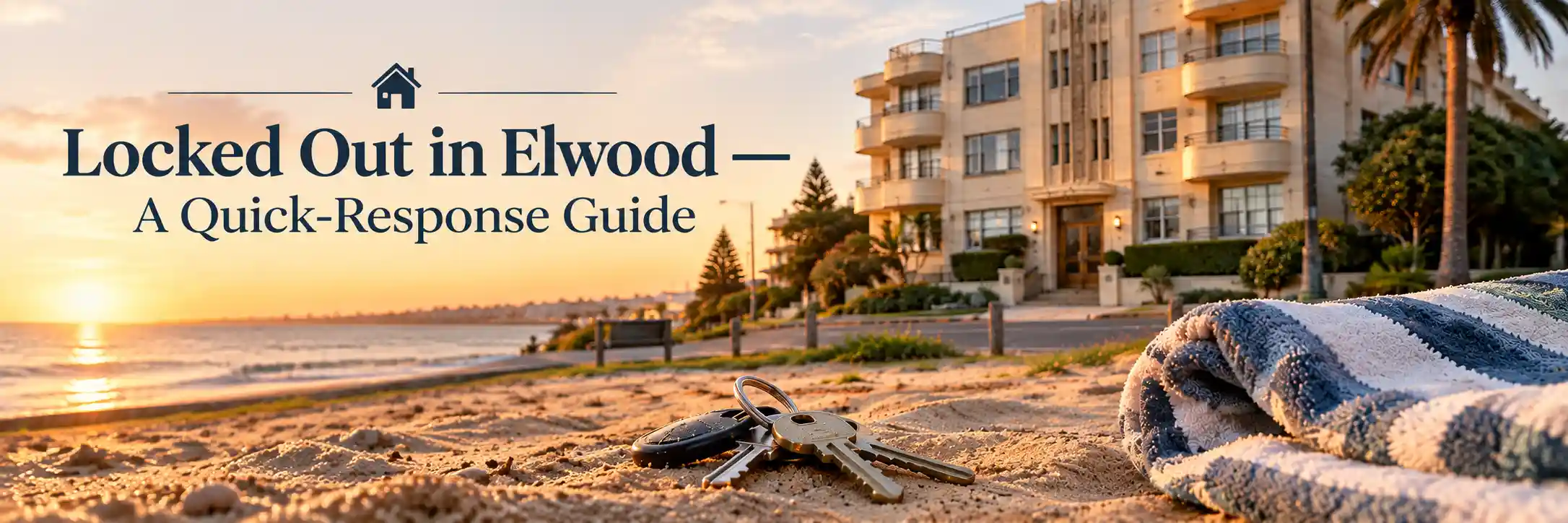
Locked out in Elwood. The key is inside, the door is shut, and the natural reflex is to search for an emergency locksmith. Before that call — and before the emergency premium that comes with it — Elwood’s specific infrastructure gives you resolution options that work faster in most situations. The suburb’s tram connections, Art Deco apartment management contacts, and bayside community character create a resolution environment that’s better than most Melbourne postcodes. Work through these in order.
First — Three Checks Before Any Call
Is there another way in? Elwood’s period houses have rear yards, side passages, and multiple entries. An unlocked back door. A window left open on the side passage. A garage. In Art Deco apartment blocks, is there a secondary entry, a car park access door, or a ground-level service access? Check everything before deciding the front door is the only option.
Where are the keys, specifically? On the kitchen bench visible through the window — genuine lockout. In the beach bag at Elwood Beach, in the café at Elwood Village, in the car — retrieval problem. Thirty seconds of retracing sometimes eliminates the situation entirely.
Who has a key? A housemate, a partner, a neighbour who’s been in the building for years. In Elwood’s long-established, community-oriented suburb — where 47% of residents are long-term — a neighbour who knows the building concierge or has the OC management number is a realistic option.
Elwood-Specific Options
Building manager or OC management. Many of Elwood’s Art Deco apartment blocks have on-call building managers or OC management companies with an after-hours contact number. In buildings where the OC maintains a physical master key for emergency access, this contact resolves the lockout without any locksmith involvement. This number is in your lease, on the building noticeboard in the lobby, or available through a long-term neighbour. It should be in your phone before any lockout happens.
Property manager after-hours line. Elwood’s 57% rental rate means most residents have this contact in their lease. A property manager who holds a spare key or who can facilitate building management contact is the resolution path before a locksmith becomes necessary.
The tram network. Elwood has strong tram connections — Route 96 along Ormond Road, Route 67 and 3 along St Kilda Road, connecting to the inner city and surrounding suburbs. If a spare key is with a partner in St Kilda, a housemate in South Yarra, or a family member anywhere along these routes, retrieval is often faster than a locksmith wait during peak periods.
The Elwood Village. The cafes and businesses on Ormond Road and Glen Huntly Road are open late into the evenings. If you’re locked out after returning from the beach, from the village, or from Elwood Beach, the village’s staffed businesses provide a place to make calls and wait comfortably while help is arranged.
Pro Tip:
The four contacts that make any future Elwood lockout a two-second decision rather than a stressed search: OC building manager or after-hours management number. Property manager after-hours line. A trusted person who holds a spare key. A verified Elwood locksmith with a current Victorian licence and good reviews. Save all four now, clearly labelled in your phone — before you need them.
Art Deco Block Lockouts — The Specific Situation
Elwood’s Art Deco apartment blocks create a specific lockout scenario that standard residential lockout advice doesn’t fully address.
Locked out of the building entry. The building’s common entry door — often with period hardware that may include an intercom system added in a later decade — may have failed or you may not have your building key. This is a building management situation: the OC contact or building manager is the first call. A locksmith who picks or replaces the common entry hardware is working on common property without OC authorisation, which creates a liability question.
Locked out of your individual apartment with building access. You’re inside the building but not your apartment. A locksmith can work on your individual lot cylinder. In Art Deco buildings, the cylinder format may be older or non-standard — tell the locksmith the approximate age of the building and whether the cylinder is original or appears to have been updated. This information shapes what equipment they bring.
Both at once. Locked out of the building and the apartment. Building management first, then locksmith as a follow-up if the apartment door needs work after building access is restored.
What Not to Do
- Don’t attempt to pick an Art Deco or period lock. Elwood’s older apartment and house stock may have mortice locks, original 1930s cylinders, or hardware in a condition that makes improvised picking attempts damaging rather than productive. Household implements in a worn mechanism turn a professional five-minute job into a cylinder replacement.
- Don’t force the door frame. In period buildings with heritage overlay protection, frame damage is expensive, visible, and potentially a heritage compliance issue as well as a repair cost.
- Don’t break a steel-framed Art Deco window. The replacement cost for heritage-matched steel Crittal-style glazing is significant and may require OC approval of the replacement specification.
- Don’t search for a locksmith without checking reviews. Melbourne’s inner south has documented predatory locksmith operators who advertise cheap rates and charge significantly more on arrival. Sixty seconds of Google Business review checking before calling is always worth doing.
- Don’t accept immediate drilling. For virtually all Elwood residential locks — Art Deco cylinder, modern deadbolt, period mortice — non-destructive entry should be the first approach. Drilling is a genuine last resort that requires a specific explanation for why it’s necessary for this particular lock.
“Elwood after-hours lockouts are a mixed bag. The Art Deco apartments sometimes have hardware we haven’t seen before — original 1930s cylinders still in use, period mortice configurations, frames that take non-standard cylinder formats. The modern apartments are straightforward. The period houses can be either. We always ask about the building age and the lock type before we mobilise. It changes what we bring.”
What to Tell the Locksmith When You Call
Precise information determines how quickly and correctly the job gets done in Elwood’s varied housing stock.
For an Art Deco or period apartment lockout:
- Building name and street address, apartment or unit number
- Whether you have building entry access or are locked out at the building level
- Approximate era of the building — 1920s-30s Art Deco, 1960s-70s walk-up, or more recent
- Lock type if known — original period hardware, modern cylinder, or uncertain
For a period house lockout:
- Full street address
- Lock type — modern cylinder deadbolt, original mortice lock with bit key, or uncertain
- Whether the property is heritage-listed if known — this affects approach
- Whether any prior entry attempt has been made
Verification Before Work Starts
- Ask for the locksmith’s Victorian security licence number
- Confirm name and company match what was given when you booked
- Get an all-inclusive total — call-out, labour, parts, after-hours loading — before authorising work
- For period hardware: ask whether they have experience with Elwood’s Art Deco and period lock types before they start
Warning:
Elwood renters: if a lockout results in a lock change rather than non-destructive entry, provide the property manager with new keys as soon as practicable under the Residential Tenancies Act 1997 (VIC). Keep the locksmith invoice. In a heritage building, confirm with the OC or property manager that the replacement cylinder is compatible with any building master key system before the locksmith installs it — installing an incompatible cylinder in an OC building can create a compliance issue on top of the original lockout.
Conclusion
The Bayside Factor — Beach and Foreshore Lockouts
Elwood Beach is a popular destination that draws residents and visitors year-round. Lockouts that happen after a beach visit have a specific character: keys left in a bag at the beach, a bag taken or lost on the foreshore, or keys locked in a car at the Marine Parade car park while carrying beach gear.
For car lockouts at the Elwood Beach car parks — Marine Parade, Ormond Esplanade — NRMA membership covers vehicle lockouts as a standard service. Non-members can access pay-per-call assistance. Elwood Beach lifesavers are present during patrolled hours and can facilitate contact with emergency services if a situation warrants it.
For house lockouts that occur after returning from the beach: the resolution options are the same as any other Elwood lockout. The beach bag is also worth checking thoroughly before making any call — keys end up under beach towels and inside books more often than lockout callers expect.
Jewish Community Resources
Elwood has a long-established Jewish community, with significant community infrastructure including synagogues, community organisations, and support services. For community members experiencing a lockout in circumstances that involve additional stress or vulnerability, Elwood’s Jewish community organisations provide welfare and support services that go beyond the immediate practical problem.
The Australian Jewish Welfare Society and community support lines can provide referrals if a lockout situation involves broader vulnerability.
A locked out Elwood situation is more solvable than the initial stress suggests. The OC building management contact resolves most Art Deco apartment block lockouts without a locksmith being involved.
The tram network makes spare key retrieval realistic. The property manager’s after-hours line is often underused in situations where it would have been faster than a locksmith call. When a locksmith is genuinely the right answer, giving them the building era and lock type upfront — and verifying their licence and confirming the total before work starts — converts what could be an expensive and stressful experience into a straightforward resolution.